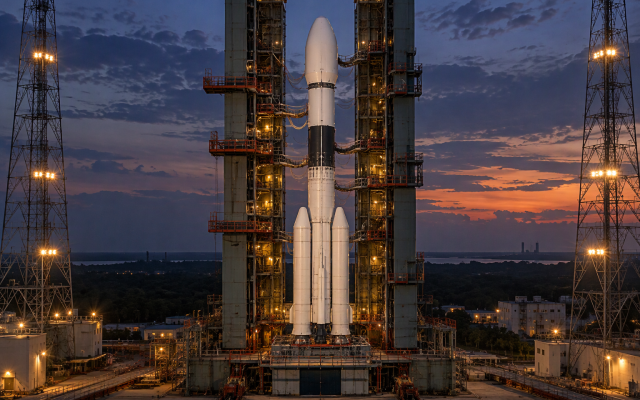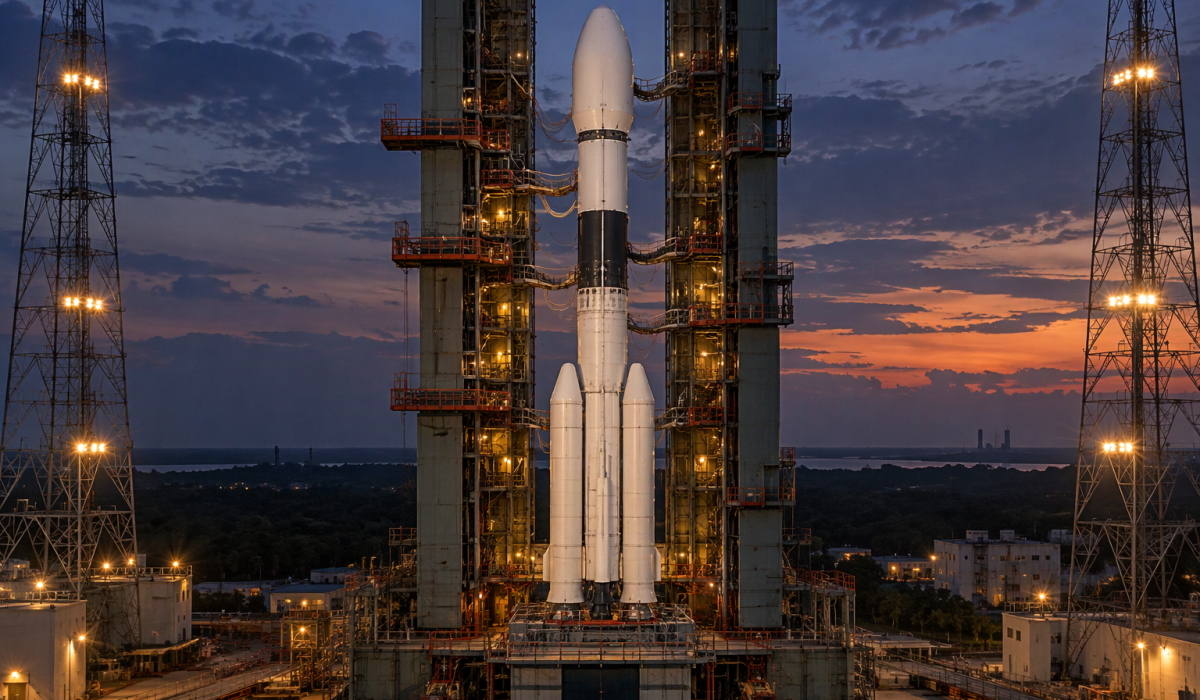
The Indian Space Research Organisation has placed the NVS-03 navigation satellite into its intended orbit. ISRO’s mission page for GSLV-F18 states that the vehicle put the satellite into a Geosynchronous Transfer Orbit and that the launch was successfully executed from the Second Launch Pad at the Satish Dhawan Space Centre in Sriharikota.
The commissioning numbers are in the agency’s own follow-up notice on orbit manoeuvring: NVS-03 was injected into a 170.3 km by 38,080 km orbit by the GSLV launch vehicle on 30 October 2026 at 23:51 hrs. That is the parking orbit from which the satellite’s own propulsion will raise it towards geostationary altitude over the coming days, so the injection figure is the launch result, not the final orbital slot.


NVS-03 is part of India’s regional navigation constellation rather than a communications or earth-observation asset. Constellation satellites of this type carry the ranging signals that make position fixes possible over India and its surroundings, with the regional footprint that makes the system useful for timing and location services in transport, agriculture and disaster response. What matters operationally is not the launch but the constellation’s health: a navigation system is only as good as the number of satellites above the horizon that are healthy enough to be used.
For ISRO, the mission also restores a launch cadence on the GSLV Mark family, the vehicle that carries the country’s heavy upper-stage work using the cryogenic engine. A successful injection from the second launch pad keeps the geosynchronous programme moving at a time when the agency’s manifest is unusually full, and the post-launch technical briefing is where the agency traditionally addresses any performance details that a two-line success statement does not carry.
The practical takeaway for users of positioning services is the interval between now and utility: a navigation satellite has to raise its orbit, drift into its assigned longitudinal slot, and pass in-orbit testing before it contributes ranging to the system. ISRO’s own mission pages are the record for each of those steps, and they are where the constellation status will be updated rather than in the launch announcement.