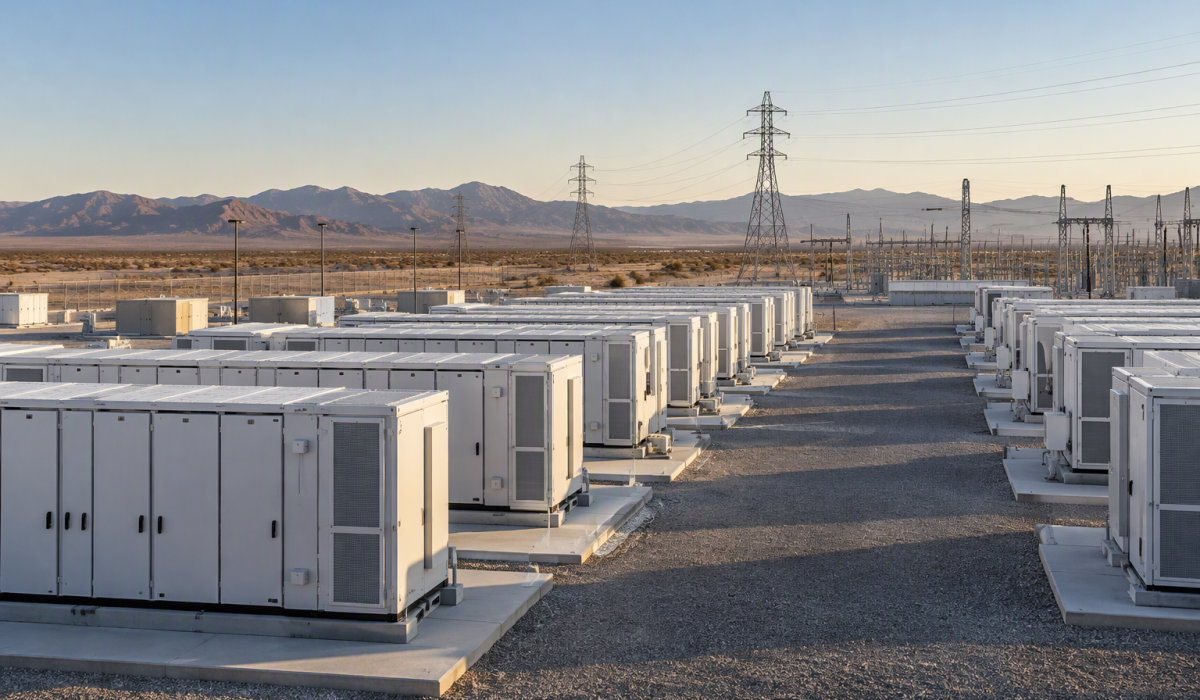
The US energy storage industry installed a record 20.2 gigawatt-hours of new capacity in the second quarter of 2026, according to industry data reported by Utility Dive.
The quarter extends a run of records. The first quarter had already set a high mark at 9.7 GWh, and analysts now expect roughly 71 GWh of new storage for the full year.


The numbers
Storage growth is being driven by a simple pairing: cheap solar during the day and batteries that move that energy into the evening. Utilities are also using batteries for reliability services that used to be provided by gas peakers.
The scale is still small relative to the overall grid, but the growth rate is what matters. Each quarter of record additions changes the operating profile of the system.
GWh versus GW
Storage is often described in two units. Megawatts or gigawatts measure power — how fast energy can flow. Megawatt-hours or gigawatt-hours measure energy — how much can be stored.
A 100 MW battery with four hours of duration holds 400 MWh. As batteries get larger and longer, the GWh number grows faster than the GW number.
What storage does
- Peak shaving: discharge when demand and prices are highest.
- Solar shifting: move midday production into the evening.
- Grid services: provide fast frequency and voltage support.
- Resilience: keep critical loads powered during outages.
The bottleneck
The constraint is no longer demand for batteries. It is the time and cost of connecting projects to the grid. Interconnection queues, transmission capacity and local permitting determine how quickly record installations can continue.
Supply chains and financing matter too, but the grid connection is often the gating item.
The bottom line
20.2 GWh in a single quarter would have been unthinkable a few years ago. The question for 2027 is whether the grid can keep up with the batteries.